
The Eternal Question

Series: Reflections From John

image“Now while he was in Jerusalem at the Passover Feast, many people saw the miraculous signs he was doing and believed in his name. But Jesus would not entrust himself to them, for he knew all men. He did not need man’s testimony about man, for he knew what was in a man.” (John 2: 23-25)

Are you a Christian? Do you believe? Are you saved? Have you accepted Christ as your personal Savior? Have you asked Jesus into your heart? If you died today, do you know where you would spend eternity? All of these are versions of the eternal question.

Posing the eternal question can make us uncomfortable. If we have doubts about someone’s salvation, failure to ask it makes us unloving. But failing to resolve the question in our own hearts can make us eternally condemned. And that makes it the most important question any of us will ever face.

My first encounter with the eternal question occurred in my teenage years during revival week at Jenkinsburg Baptist Church in my hometown of Jenkinsburg, Georgia. Like so many of the old-time preachers, Reverend Price’s pitch to me was high-pressure. He tried his best to scare me out of hell and into heaven, a technique that some have characterized as terror evangelism. I just couldn’t reconcile the Jesus he was proclaiming with the Jesus my Granny Wells was always talking about- the Jesus who was her constant companion.

But a seed was planted – a seed that would germinate ten years later. Upon reexamining the Gospel from a rational and intellectual perspective, I eventually came to the conclusion that the gospel accounts of Matthew, Mark, Luke, and John and Jesus’ declarations about himself were indeed true. Claiming the promise of John 3:16 that I had recited so many times in the Vacation Bible Schools of my youth that “whosoever believeth in him should not perish, but have everlasting life” (KJV), I was baptized at Florence Baptist Church in Forest City, North Carolina at the age of 24.

For the next twenty years, very little changed in my relationship with the Lord. I was content that those questions Reverend Price had pounded into me during that revival had been resolved. Secure in my salvation, I was confident that should my life meet an early end, my eternal destination was assured. But I was trying to live the Christian life as best I knew how in my own strength and wisdom – resources which proved woefully inadequate for the inevitable storms and temptations of life.

Thankfully, the Lord did not leave me in that condition. As he drew me to His Word, I began to pray as I had witnessed Granny Wells pray, speaking with the Lord as a personal friend, rather than a distant Deity. One morning while driving to work in Bradford, Pennsylvania, the Holy Spirit spoke to my heart in a way I had never before experienced, saying “When are you going to stop trying to do this on your own and learn to trust in me?” I was so overwhelmed by the presence of God that I pulled off the road and surrendered my life right then and there, confessing Christ once and for all as my Lord.
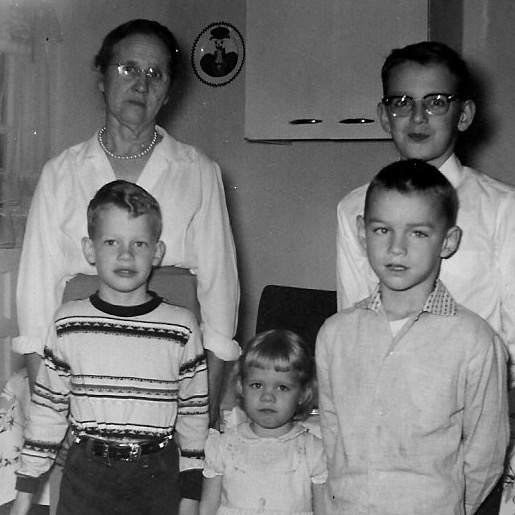
imageThe year was 1994 – the same year that Granny Wells went home to be with the Lord. Coincidence? … I don’t think so. She was a tremendous prayer warrior and I believe her prayers for me became all the more powerful the day she entered heaven. God only knows how many loved ones I will be reunited with one day in Glory because of her Godly influence and her faithful intercessory prayers.

After languishing in a nursing home for several years, she told me in one of our last conversations, “Julian, I don’t know why the Lord leaves me here.” I didn’t have an answer for her then, but I have one now. I look forward to sharing it with her when the Lord calls me home.

As far as I can recall, she never asked me any version of the eternal question. But having lived on a farm all her life, she knew the importance of preparing the soil of my heart so that one day the truth of the Gospel would take root there.

In 2 Corinthians 13:5, Paul says “Examine yourselves to see whether you are in the faith; test yourselves. Do you not realize that Christ Jesus is in you – unless, of course, you fail the test?”  It is not my place or the purpose of this post to judge the authenticity of anyone’s relationship with the Lord. But it is my responsibility as a faithful witness to share my gospel story and the truths of God’s Word to help others examine themselves.

2 Corinthians 5:10 tells us that we will all stand before the judgment seat of Christ one day and our eternity will hang in the balance. The eternal question, however we choose to express it, will be supremely relevant then. But there will be no pleading our case, no opening or closing statements, no testimony from eyewitnesses, no presentation of physical evidence, and no character witnesses. Because the One sitting on that judgment seat does not need man’s testimony – he already knows our hearts.

How tragic it would be to rest in a false sense of security concerning our answer to the eternal question, only to be reminded when it is everlasting too late of perhaps the most sobering passage in all of Scripture:

“Not everyone who says to me, ‘Lord, Lord’, will enter the kingdom of heaven. Many will say to me on that day, ‘Lord, did we not prophesy in your name, and in your name drive out demons and perform many miracles?’ Then I will tell them plainly, ‘I never knew you. Away from me, you evil-doers!'” (Matt. 7:21-23)

Note: Unless otherwise noted, all Scripture references taken from the New International Version (NIV)

Cleansing The Temple

Series: Reflections From John

imageIn the temple courts he found men selling cattle, sheep and doves, and others sitting at tables, exchanging money. So he made a whip out of cords, and drove all from the temple area, both sheep and cattle; he scattered the coins of the money changers and overturned their tables. To those who sold doves he said, ‘Get these out of here! How dare you turn my Father’s house into a market!’ His disciples remembered that it is written: ‘Zeal for your house will consume me.’” (John 2:16-17)

According to tradition, the commercial activity in the temple which had upset our Lord had once taken place outside the temple to support the sacrificial needs of Jewish pilgrims who often traveled long distances to observe the Passover. It was apparently moved into the Court of the Gentiles so that the priests could also profit from them.

But what the priests saw as convenient and profitable violated the strict rules which were designed to maintain the sanctity of the temple and provide an environment that facilitated worship and a focus on God. I don’t believe the priests found a loophole somewhere in Leviticus to allow for this. And our Lord has a low tolerance for placing the concerns of men above the concerns of God. Just ask Peter! (Matt. 16:23)

Under the New Covenant sealed by the blood of Christ, God took religion from the realm of external and made it internal. Our temple is no longer a building. 1 Corinthians 6:19-20 says “Do you not know that your body is a temple of the Holy Spirit, who is in you, whom you have received from God? You are not your own; you were bought at a price. Therefore honor God with your body.”

Just as worship must have been greatly hindered by the merchants and money-changers in the temple, the Spirit’s work in our lives is hindered by those things which take our focus off of God and undermine God’s moral will for our lives. While Jesus sacrificed for our sins “once for all” on the cross of Calvary, his death did not negate our need for cleansing of those sins we still wrestle with. Galatians 5:17 says “For the sinful nature desires what is contrary to the Spirit, and the Spirit what is contrary to the sinful nature. They are in conflict with each other, so that you do not do what you want.”

Those sins that beset us may not threaten our salvation, but they damage our relationship with the Lord and prevent us from experiencing the abundant Spirit-filled life Jesus desires for each of us. (John 10:10) The Spirit can never thrive in a heart in which the sinful nature is firmly entrenched.

To quote the great evangelist D.L. Moody,

“I firmly believe that the moment our hearts are emptied of pride and selfishness and ambition and self-seeking and everything that is contrary to God’s law, the Holy Spirit will come and fill every corner of our hearts. But if we are full of pride and conceit and ambition and self-seeking and pleasure and the world, there is no room for the Spirit of God. And I believe many a man is praying to God to fill him when he is full already with something else. Before we pray that God will fill us, I believe that we ought to pray that he would empty us.”

And so, just as Jesus cleansed the temple, we must also cleanse our hearts of those things that are contrary to the concerns of God – things that choke the Word and make us unfruitful. This includes trivial pursuits that crowd our schedules, leaving us little time for quiet communion with the Lord and meditating upon the Scriptures which are able to impart Godly wisdom to counteract the daily assaults of the world upon our thinking.

Such cleansing is not a one-time event. John placed this account of the cleansing of the temple earlier in Jesus’ ministry than the Synoptic Gospels, leading many to question if they refer to the same event. Personally, I believe Jesus encountered such activities at the temple on multiple occasions and likely responded similarly each time.

And so it is with us. It would have been convenient if the Lord had removed our sinful nature when the Holy Spirit took up residence in our heart at salvation, but he chose not to. So we must be continually aware of its impact and attentive to emptying ourselves of those things that rob us of our joy and undermine the Spirit’s work in our lives.

And that, my friends, is what cleansing is all about. Ephesians 4:31 says “Get rid of all bitterness, rage and anger, brawling and slander, along with every form of malice.” Paul could have easily added many other detrimental traits to that command.

In fact, he provides us a fairly comprehensive list in Galatians 5:19-21. I encourage you to check it out, compare those traits to your own sinful inclinations, and let the cleansing begin. I’m confident you’ll be glad you did.

“If we confess our sins, he is faithful and just and will forgive us our sins and purify (cleanse) us from all unrighteousness.” (1 John 1:9)

Note: All Scripture taken from the New International Version (NIV)


Love So Amazing

“This is how we know what love is: Jesus Christ laid down his life for us. And we ought to lay down our lives for our brothers. If anyone has material possessions and sees his brother in need but has no pity on him, how can the love of God be in him? Dear children, let us not love with words or tongue but with actions and in truth.” (1 John 3: 16-18)

image

As a fledgling writer I find myself often challenged to present a fresh perspective on very familiar Biblical accounts. At no time is this challenge greater than at Easter. After all, the story of Easter is the bedrock of our faith. The account of the events surrounding the death, burial, and resurrection of Christ comprise a significant portion of each of the four Gospels. Even after the story had been told by Matthew, Mark, and Luke, John still devoted almost 40% of his gospel to those crucial eight days. It is just that important.

Churches all over the world will be filled to capacity tomorrow with worshipers who will hear that familiar message, “He is risen!”. Recalling the traditions ingrained in us from childhood, many of us will be arrayed in our finest Sunday clothes, joining countless others in singing those Easter classics, “The Old Rugged Cross”, “Up From The Grave He Arose” “When I Survey The Wondrous Cross”, and “Because He Lives”.

We will be reminded by the Scriptures that our Lord gave up the glory of Heaven to make His dwelling among us, only to be rejected by so many whom He came to save. We will recall the agony He experienced at Gethsemane, the excruciating pain of scourging, the humiliation of being mocked at, spit upon, and having His beard plucked out. We will cringe as we imagine the spikes being driven into his hands and feet. And we will mourn as we consider what His death by crucifixion entailed. When I reflect on all that, knowing that He possessed the power to prevent it, it is almost more than I can fathom that he chose to endure it out of His love for us.

But then our hearts will rejoice once again that the grave could not hold Him. Pilate told the guards, “Go make the tomb as secure as you know how.” (Matt. 27:65) How God must have laughed at that comment, thinking “Good luck with that!”.

As we celebrate Easter, it is appropriate to remember those events. Certainly it is fitting to reflect on their implications for our lives as followers of Christ. We can rejoice as we sing to the world that we serve a risen Savior. But while doing so, we should also consider that Easter demands a response from us beyond basking in the glory of the miracle that occurred that fateful Sunday long ago.

On the night of his arrest, Jesus gathered his disciples in the upper room and spoke these words, “A new command I give you: Love one another. As I have loved you, so you must love one another. By this all men will know that you are my disciples, if you love one another.” (John 13: 34-35) Later he added, “Greater love has no man than this, that he lay down his life for his friends.” (John 15:13)

With those words, our Lord clearly articulated the appropriate response to the message of Easter. And yet, surveys continue to reveal that love is seldom the first thing that comes to mind when those outside the faith think of Christians. How that must grieve the heart of God. And it should grieve us as well.

My Sunday School class is exploring the early chapters of Acts. Acts 2:47 says “And the Lord added to their number daily those who were being saved.” What was the key to that kind of growth in the early church? Certainly, the arrival of the Holy Spirit at Pentecost played a large role. But I believe another strong factor is hinted at earlier in that verse where it speaks of them “enjoying the favor of all the people.”

What caused the favor they enjoyed among all the people around them? More than anything else, I firmly believe it was the love they had for one another. As we celebrate Easter this year, may the good news of the Gospel be just as real to us as it was to those early eyewitnesses. May the love that was poured out for us on the cross so resonate in our hearts that it overflows to those around us. May it be that love that defines us as followers of Christ. And may it be that love that once again turns the world upside down. (Acts 17:6 KJV)

Happy Easter to you all. He is risen, indeed!

“Love so amazing, so divine, demands my soul, my life, my all.” – Isaac Watts, When I Survey The Wondrous Cross

Note: Unless otherwise specified, all Scripture references taken from the New International Version (NIV)


A Miracle At Cana

Series: Reflections From John

“On the third day a wedding took place at Cana in Galilee. … When the wine was gone, Jesus’ mother said to him, ‘They have no more wine.’” (John 2:1,3)

image

The account of Jesus turning water into wine at the wedding in Cana has provided background material for numerous jokes and generated lively debates through the centuries. Christians disagree over whether the wine that resulted was alcoholic, or simply unfermented grape juice. The answer to that question usually depends upon one’s view toward the social consumption of alcoholic beverages. Personally, I’m convinced it was the real stuff!

On the surface, one cannot help but wonder why John even included this account in his gospel. It seems to be a strange miracle with little divine purpose. No other gospel writer found it worthy of telling. Jesus even seemed initially reluctant to address his mother’s concern that the wine had run out, telling her “Dear woman, why do you involve me? … My time has not yet come.” (John 2:4)

Neither did this miracle appear to serve a great public purpose at the time. In fact, only Mary, Jesus, the disciples, and the servants likely knew that a miracle had even taken place. Jesus generated no great spectacle surrounding the event. He didn’t stand over the water pots, wave his hands over them, or utter some powerful prayer. He simply gave instructions to the servants to fill the pots and serve the contents.

Given that John elected to detail only seven miracles in his gospel, why include this one? Although some have tried to use this account to justify their consumption of alcoholic beverages, I don’t believe John’s purpose was to resolve this debate among Christians.

Mary’s instructions to the servants to “Do whatever he tells you” (John 2:5) certainly serve a great spiritual purpose, reminding us of the importance of being sensitive to the leading of the Holy Spirit in our lives and obeying him promptly when his directions are clear. This lesson has served me well through the years taking me down many worthwhile paths I might have avoided otherwise – a topic I covered in “The Paths Of Life”.

Mary’s actions also provide a picture of effective prayer. All of us are likely guilty of suggesting to God how he should respond to our prayers, as though we know what is best. But we don’t see what God sees and his solutions often far exceed our wildest expectations. I doubt that Mary had any idea what was about to take place, any more than we do when we bring a problem to him in prayer ourselves. She doesn’t suggest what to do or how to do it. She just brought her problem to Jesus, trusting him with the solution.

While these are worthwhile spiritual applications to be taken from this account, I don’t believe John was thinking of either of them when he decided to include this miracle. I believe John’s sole purpose for including this miracle among the seven he details is stated clearly in verse 11. “This, the first of his miraculous signs, Jesus performed at Cana in Galilee. He thus revealed his glory, and his disciples put their faith in him.”

John likely recorded this miracle simply because it was the first miracle he saw Jesus perform, thus sealing in his mind once and for all that Jesus was more than a teacher or prophet – he was the Son of God, just as John the Baptist had proclaimed. John concedes at the end of Chapter 20 that Jesus performed “many other miraculous signs” which he did not record. But he chose seven specifically “that you may believe that Jesus is the Christ, the Son of God, and that by believing, you may have life in his name.” (John 20: 30-31)

All of us have a story to tell. If you are a follower of Christ, you have your own “gospel” story – a term that simply means “good news”. You too can point to a time in your life when the veil over your heart was first lifted and Christ revealed himself in a way that was undeniable and that forever changed your heart, renewed your outlook on this life, and transformed your expectations of life beyond this one.

Share your gospel story with someone this Easter season. As Mary commanded the servants at the wedding, do whatever The Lord tells you. Jesus has commissioned us all to be his “witnesses in Jerusalem, and in all Judea and Samaria, and to the ends of the earth.” (Acts 1:8) That hour you first believed might not have resulted from something as dramatic as the miracle John witnessed, but it is no less life-changing. And it is likely just as compelling to someone desperate for the hope they see in you – a hope that only God can provide.

“How precious did that grace appear, the hour I first believed.” – Amazing Grace, John Newton

Note: All Scripture references from the New International Version (NIV)


A Man Called Peter

By Julian Wells

“The first thing Andrew did was to find his brother Simon and tell him, ‘We have found the Messiah’ (that is the Christ). And he brought him to Jesus. Jesus looked at him and said, ‘You are Simon, son of John. You will be called Cephas’ (which, when translated, is Peter). (John 1:41-42)

Of all the original disciples, Peter is perhaps my favorite. I see qualities in his personality that I often wish were more ingrained in my own. Those who know me and have interacted with me through the years would likely describe me as quiet, introverted, and contemplative – someone who often overanalyzes a situation before taking action. My wife informs me that her first impression was that I was “stuck up”.

Peter was none of those things. Peter was impulsive, often speaking or acting before fully thinking things through. He did not hesitate to say what was on his mind – a trait which sometimes made him the target of Jesus’ rebukes. During Jesus’ public ministry, Peter served as the de facto spokesman for the disciples.

When Jesus asked his disciples in Matt. 16:13 “Who do people say the Son of Man is?”, it was Peter who proclaimed “You are the Christ, the Son of the living God.” It was Peter who said what I’m sure the others were thinking when Christ told them of his impending crucifixion, “Lord, this shall never happen to you!” (Matt. 16:22), drawing a stinging rebuke from the Lord. It was Peter who confidently declared “Even if all fall away on account of you, I never will. …Even if I have to die with you, I will never disown you.” (Matt. 26:33 -35) But then it was also Peter who later lied when confronted at Christ’s trial, “I don’t know the man!” (Matt. 26:74)

But not only was Peter quick to speak, he was also a man of action. When Jesus called him to become a fisher of men, he didn’t hesitate – he took immediate action. When he saw Jesus walking on the water, Peter was the one who left the boat to walk with him.  When the crowd came to take Jesus, it was Peter who drew his sword to prevent it. And it was Peter who arrived first at the tomb when the women reported to the disciples that Jesus’ body was missing.

John tells us that before Peter was Peter, he was Simon, brother of Andrew. Andrew had been a disciple of John the Baptist, but followed Jesus without hesitation when John pointed to Christ as the “Lamb of God”. The first thing Andrew did was find Simon and bring him to Jesus. According to John, Jesus’ first words to Simon were, “You are Simon, son of John. You will be called Cephas.” (John 1:42)

Cephas is the Aramaic name for rock; Petros (or Peter) is the Greek equivalent. If our knowledge of Peter were limited to the gospel accounts, it would be hard to justify changing Simon’s name to be synonymous with rock. While he walked with Jesus, Peter was often anything but. He started to sink like a rock when he tried to walk on water. Peter talked a good game, but his actions didn’t always match his rhetoric.

So what did Jesus see that others didn’t? … He saw Peter’s future. God always sees our future. He knows our potential. Peter is perhaps the best Biblical illustration that God knows us better than we know ourselves. When Peter confidently proclaimed in the Upper Room on the night of Jesus’ arrest that he was ready to die with Christ, he likely believed that with all his heart. But Jesus knew that before that long night would be over, Peter would disown him three times. (John 13:37-38)

When God looks at us, he sees beyond our present to our potential and our future. He knows the plans he has for us (Jer. 29:11), and he’s always working things together to fulfill those plans. (Rom. 8:28)  God had great plans for Peter, who would become known as a “pillar” of the early church. (Gal. 2:9) In that sense, he was that rock upon which Jesus said He would build His church. (Matt. 16:18) Jesus foresaw Peter preach that amazing message on the Day of Pentecost recorded in Acts 2, which resulted in an influx of 3,000 new believers.

He might have denied Christ after His arrest, but after he encountered the resurrected Lord, he never denied Him again. He was imprisoned numerous times for preaching the gospel and healing people in the name of Christ. When challenged by the Sanhedrin for those activities, Peter boldly replied “We must obey God rather than men!” (Acts 5:29)

Did Peter continue to suffer failures? … Absolutely! … Don’t we all?  But just as I’m glad that my wife’s first impression of me did not define our future together, I’m overjoyed that in spite of my long and often halting and erratic faith journey, God never lost sight of my potential. He continued to mold me more into the image of his Son and used me in ways I would never have imagined when he first called me to himself … especially considering how different he made me compared to a man called Peter.

“I may not be the man I want to be; I may not be the man I ought to be; I may not be the man I could be; I may not be the man I truly can be; but praise God, I’m not the man I once was!” – Martin Luther King, Jr.

Note: All Scripture references from the New International Version (NIV).