A Mirror Into the Soul

“But be doers of the word, and not hearers only, deceiving yourselves. For if anyone is a hearer of the word and not a doer, he is like a man who looks intently at his natural face in a mirror. For he looks at himself and goes away and at once forgets what he was like. But the one who looks into the perfect law, the law of liberty, and perseveres, being no hearer who forgets, but a doer who acts, he will be blessed in his doing.” (James 1:22-25 ESV)

imageI love the mental image this verse conjures up in my mind – the image of looking at my reflection in a mirror. It speaks to the perspective we should adopt as we open up God’s Word.

Whenever I look into a mirror, I am focused on my outward appearance. Do I need to shave or comb my hair? Did I cut myself shaving this morning? Is anything hanging out of my nose?

When we peer into God’s Word, we should think of it as a mirror into our inner appearance. Do my thoughts and attitudes reflect the heart of God as revealed in the Scriptures? Hebrews 4:12 says, “For the word of God is alive and active. Sharper than any double-edged sword, it penetrates even to dividing soul and spirit, joints and marrow; it judges the thoughts and attitudes of the heart. (NIV)

Instead, all too often I tend you use God’s Word as a magnifying glass through which I look to judge everyone around me. From time to time this has led to a few caustic comments on social media which I quickly came to regret when they led to unfruitful and contentious discussions. Such encounters rarely change opinions, but they sometimes fracture relationships.

2 Timothy 2:23-24 wisely counsels us, “Don’t have anything to do with foolish and stupid arguments, because you know they produce quarrels. And the Lord’s servant must not be quarrelsome but must be kind to everyone, able to teach, not resentful.” (NIV)

In this day when the widespread use of social media impacts so many of our relationships, we would all be wise to heed Paul’s advice to Timothy. And as we read God’s Word, we should be more mindful of the logs in our own eyes as revealed by Scripture and less focused on the specks in the eyes of others. (Matthew 7:5)

“Let your conversation be always full of grace, seasoned with salt, so that you may know how to answer everyone. (Colossians 4:6 NIV)

Reflections on Election 2016

“No one serving as a soldier gets entangled in civilian affairs, but rather tries to please his commanding officer.” (2 Timothy 2:4)

imageThings that don’t mix well: oil and water, Coke and Mentos, drinking and driving, politics and religion. Upon his 98th birthday this week, I was reminded of the response of Billy Graham when asked what he would do differently as he reflected over the course of his ministry. He replied that among other things, he would have “steered clear of politics”. (Christianity Today interview, Jan. 21, 2011)

I cringe every time I hear a political dialogue initiated at my church, knowing that such conversations threaten unity and distract those who hold different views, often disrupting their spirit of worship. As a teacher, blogger, and user of social media, I have always tried to avoid political discussions and comments for those very reasons.

The divisive nature of the recent election has only reinforced my personal aversion to traveling down those roads. Nevertheless, after much soul-searching, I feel compelled to share a few concerns that are weighing heavily on my heart in the aftermath of the election this week.

Over the course of this long political season I have personally witnessed a number of insensitive and irreverent comments and jokes concerning the candidates voiced by fellow Christians, many of which occurred during church activities. Such remarks often offend those who hold different political views, making them feel uncomfortable at best and unwelcome in our congregations and small groups at worst.

In the interest of unity, I have held my tongue as the names of President Obama, Secretary Clinton, and Mr. Trump have been uttered with disdainful and often disrespectful tones. I have been shocked and greatly disappointed by blatantly false, slanderous, and even racist political emails forwarded and social media posts shared by fellow church members, friends, and family throughout the course of this campaign. Such actions fly in the face of clear Biblical teaching to be respectful of those in authority and to slander no one. (1 Tim. 2:1-3, 1 Peter 2:17, 1 Peter 2:1, Eph. 4:31-32)

I must confess that I have been both surprised and disillusioned by such widespread and often enthusiastic support among so many evangelicals for a candidate whose actions and words appear so antithetical to the Biblical values of humility, grace, and forgiveness which we espouse. When cloaked in the mantle of Christian faith, I fear that such actions undermine our moral authority and credibility as the witnesses we are called to be. It is regrettable that to the public at large, the term “evangelical” now often conveys a political overtone rather than a Great Commission mandate.

Given the closeness of the Presidential vote this week in the face of such widespread evangelical support for the Republican ticket, it should be obvious that a large percentage of those outside our faith do not share the same political views. It pains me to think that many of those individuals will likely be even more resistant to Gospel-centered conversations as a result of recent actions and words of Christians, including some very prominent Christian leaders, in the context of this election.

Exit polls also reveal a great divide in the political leanings of white evangelicals compared to our minority brothers and sisters in Christ, to which we would be wise to be sensitive. Unity in the Body of Christ was a grave concern of Christ when he offered up that great priestly prayer found in John 17, and it should be a grave concern to us as well.

Personally, the disappointment and concern I have expressed here has in no way shaken my faith in God or my trust in his sovereignty. I am well aware that Daniel 2:2 informs us that he “deposes kings and raises up others”. But the testimony of Scripture also reminds us that sometimes he gives his people the leaders they ask for, and those haven’t always worked out so well. (1 Samuel 8:7, Ezekiel 14:3-5)

Having said all that, as commanded by Scripture, I will pray for and show respect for our new President, as well as those who supported him. I pray that he will prove himself to be more knowledgeable, disciplined, respectful, inclusive, and open to opposing views than he has demonstrated over the course of this contentious campaign.

While I may disagree with many of his policy proposals and am repulsed by so many of his words and actions, I will refrain from publicly disparaging his character or sharing false, misleading, and slanderous emails and social media posts, refusing to respond in kind to so many who have not hesitated to bombard my inbox and news feeds with such content.

This is the first politically themed article I have posted on this site, having wrestled more with my decision to publish it than with anything else I have written to date, knowing that many will not receive it with the same level of prayerful consideration by which it was drafted, extensively edited, and published.

I much prefer to focus on the things that should unite us as Christians – the concerns of God, rather than the concerns of men, (Matt. 16:23) resting on the assurance of Psalm 103:19 that “The Lord has established his throne in heaven, and his kingdom rules over all.”

I pray that more Christians will join me in that focus, working toward healing the divide that has been unearthed in the Body of Christ this week and undoing any damage to our Gospel witness. Colossians 4:6 reminds us to “Let your conversation be always full of grace, seasoned with salt, so that you may know how to answer everyone.” May that be the salt that defines us rather than the kind of salt that inflicts pain when rubbed into the wounds of political disappointment.

May we never forget as we celebrate political victories, as Jesus proclaimed before Pilate, that our kingdom is not of this world. (John 18:36)

“Do not put your trust in princes, in human beings, who cannot save.” (Psalm 146:3) “It is better to take refuge in the LORD than to trust in humans. (Psalm 118:8)

Note: All Scripture references taken from the New International Version (NIV)
The Light of the Gospel

“The god of this age has blinded the minds of unbelievers, so that they cannot see the light of the gospel of the glory of Christ, who is the image of God. … For God, who said, ‘Let light shine out of darkness,’ made his light shine in our hearts to give us the light of the knowledge of the glory of God in the face of Christ.” (2 Cor. 4: 4,6) 

Fall has arrived in all its splendor here in the mountains of western North Carolina. Visitors are flooding into our sleepy little communities and navigating our winding roads to bask in the wonder of God’s creation and to capture that perfect photo for posting on social media.

Not being much of a photographer myself, I’m usually disappointed with my own photos. imageThey rarely adequately convey the breathtaking beauty of the Creator’s artistry. One trick that works well for capturing the vivid colors of autumn is positioning the camera so that the sunlight forms a backdrop for the shot. This technique greatly enhances the natural colors, as the light filters through the leaves and creates the appearance of a “tree with the lights in it”, as perfectly articulated by Annie Dillard in her Pulitzer Prize-winning work, Pilgrim at Tinker Creek. This photo I took of a copse of aspens in Estes Park, Colorado a couple of years ago serves as an example.

Experts tell me that lighting is an essential key to taking good photographs. God’s Word tells me that lighting is also a vitally important key to being an effective witness for Christ.  2 Cor. 3:18 says, “And we, who with unveiled faces all reflect the Lord’s glory, are being transformed into his likeness with ever-increasing glory, which comes from the Lord, who is the Spirit.” 

It grieves my heart, as I’m sure it grieves God, when I hear of seekers who have been turned away from the Christian faith by the actions of those believers who all too often serve as a barrier to God rather than a conduit. It grieves me even more when I stop to consider how often I have likely been that barrier myself.

Paul tells us in Galatians that our flesh constantly struggles against God’s Spirit for control of our hearts. When the flesh temporarily wins that battle, the light of the Gospel dims and we begin to blend into the woodwork of humanity. But when we surrender to the leading of his Spirit, God’s glory sets us apart from the crowd and draws others to the Christ who resides in our hearts, just as the autumn splendor of God’s creation is drawing so many visitors to these mountains arrayed in their annual October palette of colors and light, perfectly blended.

Never forget that people are always watching. They may not know a word of Scripture – they may not even own a Bible. But we are surrounded by people looking for light in an often dark and gloomy world. May they see that light in us that we might be the conduit Christ uses to draw them to himself.

“Then one day I was walking along Tinker Creek thinking of nothing at all and I saw the tree with the lights in it.  I saw the backyard cedar where the mourning doves roost charged and transfigured, each cell buzzing with flame. … I have since only rarely seen the tree with the lights in it.  The vision comes and goes, mostly goes, but I live for it, for the moment when the mountains open and a new light roars in spate through the crack, and the mountains slam.”Annie Dillard, Pilgrim at Tinker Creek

Note: All Scripture references taken from the New International Version (NIV)

The Closeness of God

“You answer us with awesome and righteous deeds, God our Savior, the hope of all the ends of the earth, and of the farthest seas, who formed the mountains by your power, having armed yourself with strength, who stilled the roaring of the seas, the roaring of their waves, and the tumult of the nations. The whole earth is filled with awe at your wonders; where morning dawns, where evening fades, you call forth songs of joy.” (Psalm 65:5-8) 

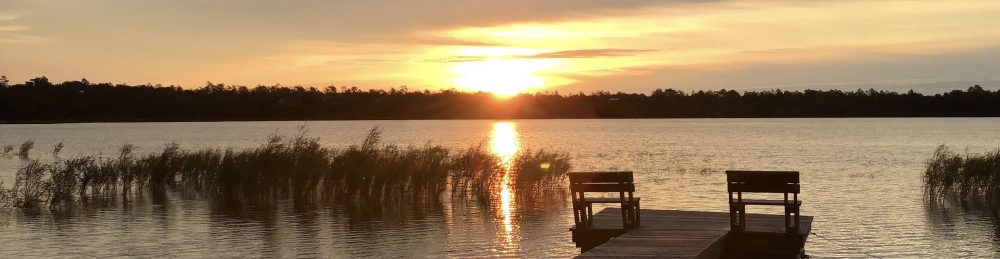
I love sunsets. Any of you who follow me on Facebook probably know that by now, given the number of sunset photos I have posted through the years. From the comfort of my deck I have a front row seat to the sun setting each night over the Blue Ridge Mountains to the west of my home in Western North Carolina. That view inspired the name for this blog, Ridgetop Reflections.

imageIt amazes me just how unique each sunset appears. Quite often they take my breath away and sometimes even leave me in tears. They never fail to remind me of the closeness of God’s presence. And I don’t believe it is a coincidence that the most awe-inspiring sunsets seem to appear when I most need to be reminded just how close God actually is.

In the Scriptures God reminds us over and over that he is always with us. When Moses felt inadequate for the task God assigned him, God reassured him “I will be with you.” (Ex. 3:12)  When Joshua felt unworthy of replacing Moses and incapable of leading Israel into the Promised Land, God challenged him to “Be strong and courageous. Do not be terrified and do not be discouraged, for the Lord your God will be with you wherever you go.” (Joshua 1:9)  When Jeremiah objected that he was too young to serve as God’s prophet, God declared, “Do not be afraid of them, for I am with you and will rescue you.” (Jer. 1:8)

The familiar words of the 23rd Psalm echo “Even though I walk through the valley of the shadow of death, I will fear no evil for you are with me; your rod and your staff, they comfort me.” (Psalm 23:4)  When God himself made his dwelling among us in the person of Christ, his name as foretold by Isaiah was Immanuel (Isaiah 7:14), which literally means “God with us”. (Matt. 1:23)  And through the person of the Holy Spirit, God fulfills his promise to be with usalways, to the very end of the age.” (Matt. 28:20)

When you face the inevitable trials and heartaches of this life, take time to reflect on those promises from God’s Word. Remember that the God who created us and who made his dwelling among us in the person of Christ now lives within us in the person of the Holy Spirit. Even in our darkest days, when sometimes he seems so distant, God is closer than we realize.

If you don’t currently have a sanctuary where you are able to just be still and sense his presence, I encourage you to find one and return to it often. As for me, I can’t wait to see the sunset he paints for me tonight!

“The most holy and necessary practice in our spiritual life is the presence of God. That means finding constant pleasure in his divine company, speaking humbly and lovingly with him in all seasons, at every moment, without limiting the conversation in any way.” – Brother Lawrence, The Practice of The Presence of God

Note: All Scripture references from the New International Version (NIV)

To The Fields!

By Julian Wells

Series: Lessons From The Cotton Field

“When he saw the crowds. he had compassion on them, because they were harassed and helpless, like sheep without a shepherd. Then he said to his disciples, ‘The harvest is plentiful, but the workers are few. Ask the Lord of the harvest, therefore, to send out workers into his harvest field.” (Matthew 9:36-38 NIV)

imageMy wife recently purchased a stalk of cotton, placing in it in a vase to serve not only as a decoration for our living room, but also as a reminder of this series and the lessons I learned in the cotton fields of my youth. Last year, as I drove by those same cotton fields in South Georgia that inspired this series, the above verses from Matthew’s gospel came to mind. They reminded me of one last lesson from the cotton fields which, while seemingly obvious on the surface, is often neglected in practice.

As I recall those days, I’m reminded that very little work was ever accomplished in the comfort of our home. Daddy would educate himself on the latest developments in the propagation, maintenance, and harvesting of crops. But all the work that had a true impact- the preparation of the soil, the planting of the seed, the application of fertilizer, the initial removal of excess cotton plants, the hoeing of weeds that would choke the remaining plants, the spraying of insecticides to control boll weevils, and the eventual harvesting that put food on our table and clothes on our back – took place in the fields. As followers of Christ, the work he has commissioned us to carry out takes place in the fields as well.

On another recent trip south, my wife and I were in Callaway, Florida, just outside of Panama City, enjoying some time with our grandchildren before they returned to school. Just down Tyndall Parkway from the hotel where we stayed, there is a new church advertising itself as “the perfect church for imperfect people”. The most intriguing aspect to me about this church is its location next door to a small plaza housing an electronic cigarette shop, a payday loan lender/pawn shop, and a tattoo parlor.

Initially struck by the irony of the site selection committee’s choice of that location, my views changed as I reflected upon the true mission of any local church. Those establishments next door exist to fulfill the perceived needs of imperfect people, be they financial, addictive, or simply products to establish or bolster an identity – needs that are better addressed by the Gospel of Christ which is now being proclaimed in that new building among that sea of imperfect people.

Sometimes we tend to forget that the bulk of the work for which we have been commissioned takes place in the fields of those imperfect people who are often more like us than we dare to admit. We grow too comfortable in our enclaves of fellow believers, preaching to and teaching one another, taking Bible study after Bible study, and enjoying the fellowship of other like-minded believers, while the world around us is starved for the hope that only the Lord we proclaim can provide.

It is fitting and proper that we gather to worship our Lord, to enjoy fellowship with one another, to encourage and pray for one another, and to equip ourselves for the greater work of spreading the Good News. But we must never forget that the greater work takes place outside the walls of the church building. We are called to be salt and light in a world filled with imperfect people and in a culture that is often hostile to our message.

Rather than withdrawing from that culture, we should engage it as Christ did, realizing that a life modeled on Biblical principles is a powerful testimony in itself. Then we must be prepared to give an answer for the hope that others see in us. (I Peter 3:15)

After class some years ago, a dear friend once commented that she wished she knew the Bible as well as I do. I replied, “I wish I lived the Bible as well as you do!” On the night before his crucifixion, Jesus said to his disciples, “I have set you an example that you should do as I have done for you. I tell you the truth, no servant is greater than his master, nor is a messenger greater than the one who sent him. Now that you know these things, you will be blessed if you do them.” (John 13:15-17 NIV)

Unless we put its teachings into practice, few people will ever be impacted by our knowledge of the Scriptures. James 2:17 says “In the same way, faith by itself, if it is not accompanied by action, is dead.” Faith without works and knowledge without action, like that stalk of cotton in my living room, is little more than a decoration.

As I learned in the cotton fields of Georgia, the work of growing the Kingdom of God takes place in the fields – not in our comfort zones. The harvest is still plentiful and all too often the workers are still too few. That might not be the case if we were as concerned over the fields of lost people all around us as we are uncomfortable around some of them.

All too often the church holds up a mirror reflecting back the society around it, rather than a window revealing a different way.” ~ Philip Yancey