On The Other Hand

“I know that nothing good lives in me, that is, in my sinful nature. For I have the desire to do what is good, but I cannot carry it out. … What a wretched man I am! Who will rescue me from this body of death?” (Romans 7:18, 24)

Dr. Charles Stanley once used an illustration that has stuck with me through the years. I have cited it often in lessons I’ve taught and was reminded of it again last week when my morning devotion brought me to Romans chapters 7 and 8.
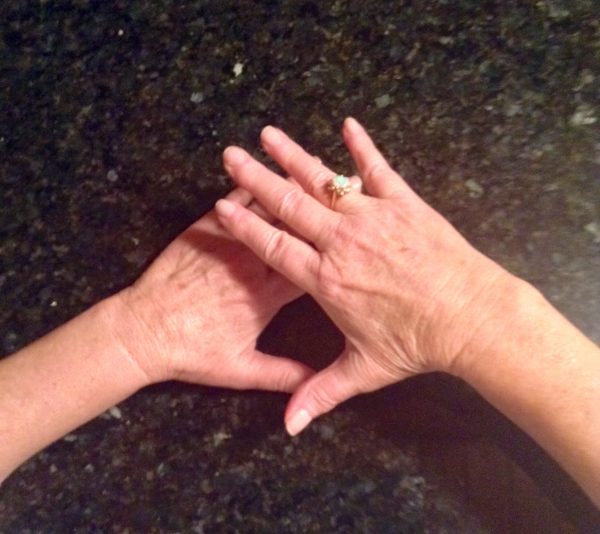
Hold your hands out in front of you, putting one in front of the other, focusing intently on the hand nearest you. Notice how the other hand subtly fades from view in your mind.

Now imagine that one hand represents your circumstances, while the other hand represents the promises of God. Do you see where I’m going with this?

In the midst of life’s inevitable difficulties, disappointments, pain, and struggles, we can easily allow life’s circumstances to cloud our view of God’s promises. When you find yourself in that situation, it is important to figuratively change the position of your hands, view your circumstances through the lens of God’s promises, and watch the gravity of those circumstances fade in comparison.

There may be no better Biblical example of that dynamic than that provided by Paul in chapters 7 and 8 of Romans.

In chapter 7, Paul’s focus turns to his personal struggles with sin, lamenting that “nothing good lives in me” – that while he desires to do good, he often finds himself doing otherwise. (verse 18-19) While all of us can relate to those internal battles with the flesh, other circumstances often capture our focus as well – such as the loss of a loved one, a life-threatening illness, or the loss of a job – to name just a few.

Any of those situations can lead us to cry out with Paul in verse 24, “What a wretched man I am! Who will rescue me from this body of death?” But notice how Paul’s focus abruptly turns to the promises of God, answering his own question in verse 25, “Thanks be to God through Jesus Christ our Lord!

In chapter 8, Paul then proceeds to enumerate five (one for each finger) of the most profound promises of God contained in all of Scripture:

  • “Therefore, there is now no condemnation for those who are in Christ Jesus, because through Christ Jesus the law of the Spirit of life set me free from the law of sin and death” (Romans 8:1)
  • “The Spirit himself testifies with our spirit that we are God’s children. Now if we are children, then we are heirs – heirs of God and co-heirs with Christ, if indeed we share in his sufferings in order that we may also share in his glory.” (Romans 8:16-17)
  • “I consider that our present sufferings are not worth comparing with the glory that will be revealed in us.” (Romans 8:18)
  • “And we know that in all things God works for the good of those who love him, who have been called according to his purpose.” (Romans 8:28)
  • “No, in all these things we are more than conquerors through him who loved us. For I am convinced that neither death nor life, neither angels nor demons, neither the present nor the future, nor any powers, neither height nor depth, nor anything else in all creation, will be able to separate us from the love of God that is in Christ Jesus our Lord.” (Romans 8:37-39)

I encourage you to highlight these five verses in your Bible. And the next time life’s inevitable circumstances start to divert your focus to the wrong hand, allow the Spirit of God to redirect your gaze to these uplifting, unchanging, and unbreakable promises on the other hand.

You’ll be glad you did.

“If you look at the world, you’ll be distressed. If you look within, you’ll be depressed. If you look at God, you’ll be at rest.” – Corrie ten Boom

(All Scripture references taken from The New International Version, NIV)

Love Is Not a Zero-Sum Game

“Hearing that Jesus had silenced the Sadducees, the Pharisees got together. One of them, an expert in the law, tested him with this question, ‘Teacher, which is the greatest commandment in the Law?’ Jesus replied, ‘Love the Lord your God with all your heart and with all your soul and with all your mind. This is the first and greatest commandment. And the second is like it: Love your neighbor as yourself. All the Law and the Prophets hang on these two commandments.'” (Matthew 22:34-40 NIV)

Upon encountering these verses in a morning devotion earlier this week, I found myself wondering how many times I must have read or even quoted Christ’s reply to this question without stopping to consider its full implications and duly examining my own heart in response.

Our familiarity with this passage tempts us to casually pass over it as though Christ might have answered, “Love the Lord your God and love others as yourself. Next question?” Or even “Love the Lord your God with your heart, soul, and mind and love others likewise.”

But given that Jesus said these are the greatest commandments and that all the Law and the Prophets hang on them, it certainly behooves us to ponder that sticky little word, all, which adds tremendous gravity to our Lord’s reply.

At first glance, one might easily assume that loving God with all our heart, mind, and soul might come at the expense of our love for others as though our capacity to love might be limited somehow. But love is not a zero-sum game. In fact, when love is properly directed, just the opposite is true.

Scripture tells us that God is love. (1 John 4:8) As our love for God increases, his love actually expands our heart’s capacity to love others. I believe that is why Jesus links the two in this passage. I have seen this truth manifested in my own life. As my wife and I have grown closer to the Lord through the years, it has only deepened and enhanced our love for each other.

After wrestling with this passage and confessing “Lord, I do love you with all my heart, mind, and soul”, the echo I hear in response is “Now channel that love to others.”

When I truly examine my heart, I’m well aware of how far short I fall of God’s glorious standards (Romans 3:23), whether it be in this, the greatest commandment, or any other area of concern to him. But that only increases my love for the One who is perfect in his love for me – so much so that he sent his Son to live the life I cannot live and to pay the debt I cannot pay.

It is that love that compels me to pay closer attention when I encounter these words of my Lord, to strive to make loving God my first priority every day, to love him with all my being, and to be mindful of anything in my life that hinders that wholehearted devotion.

“No love of the natural heart is safe unless the human heart has been satisfied by God first.” – Oswald Chambers


Finding Hope Through Affliction

“Come to me, all you who are weary and burdened, and I will give you rest. Take my yoke upon you and learn from me, for I am gentle and humble in heart, and you will find rest for your souls. For my yoke is easy and my burden is light.” (Matthew 11:28-30 NIV)

This verse came to mind this morning on the third anniversary of my brother’s passing through the gates of Heaven. While my grief certainly remains, it comforts me to know that he is enjoying a peace and rest that surpasses all earthly experience and human understanding.

As many of you know, Ronnie suffered for many years with diabetes and other complications that stemmed from that. Through those years I offered up countless prayers on his behalf.

But there is one prayer that I especially remember. It happened during the worship service one morning at our church in Fredericksburg, Virginia – Spotswood Baptist Church.

As we sang the hymn of invitation, I was overcome by a sudden burden to pray for Ronnie. I don’t remember the details of that prayer – perhaps it was that God would miraculously heal him. But I do vividly recall God’s response that morning and the incredible warm feeling of peace that coursed through my veins when I heard a still, small voice say, “Ronnie is going to be all right.”

Little did I understand that morning what God meant by that assurance. But looking back through eyes of faith, I realize now that God did not mean he would heal Ronnie of diabetes – not in this life anyway. He did something even better. He revealed himself to my brother in ways that Ronnie might never have experienced had it not been for the affliction he suffered through all those years.

As I reflect on that, I can’t help but imagine how differently things might have turned out if God had answered my prayers through the years and miraculously healed Ronnie. While it might have eased his pain and suffering in this life, it might also have removed the catalyst God used to draw Ronnie to himself.

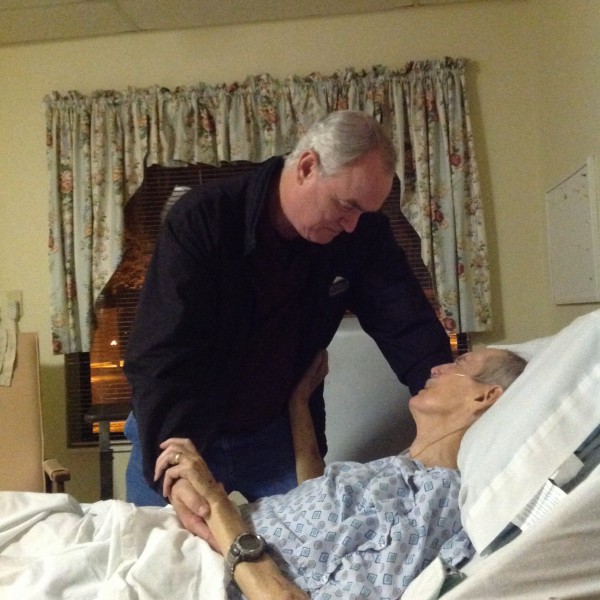
Just before I left his bedside on the morning before the Lord called him home, after a difficult night, Ronnie briefly rallied. When our nieces, Elaine and Teresa, stopped by on their way to work and asked how he was doing, he raised both arms in the air and declared, “I’m all right!”. Eighteen hours later he passed into eternity.

Only as I was drafting this post did it dawn on me that those words from Ronnie’s lips that morning echoed so clearly the words spoken to me by that still, small voice in that church pew over twenty years before.

Indeed he is all right – as “all right” as he has ever been, resting safely in the presence of his Savior. And for that I rejoice, knowing that there will be no goodbyes when I join him there one day.

“The idea of heaven can be a consolation for suffering, a compensation for the life we have lost. But resurrection is not just consolation – it is restoration. We get it all back – the love, the loved ones, the goods, the beauties of this life – but in new, unimaginable degrees of glory and joy and strength.” – Tim Keller


Hearing God’s Voice

By Julian Wells

“My son, if you accept my words and store up my commands within you, turning your ear to wisdom and applying your heart to understanding, and if you call out for insight and cry aloud for understanding, and if you look for it as for silver and search for it as for hidden treasure, then you will understand the fear of the Lord and find the knowledge of God. For the Lord gives wisdom and from his mouth come knowledge and understanding.” (Proverbs 2:1-6 NIV)

My one-word resolution for 2018 is mindful. Previous posts have explored my intent to be more mindful of my time and more mindful of others this year. The third area I intend to be more mindful this year is in hearing God’s voice, especially when it comes to daily Bible reading.

I have always been a fast eater – a tendency which studies suggest leads to higher caloric intake but less satisfaction. Similar problems can ensue in a spiritual sense when we follow aggressive Bible reading plans as I have for a number of years.

As I covered in a post titled Bible Reading Plans last year, such plans can lead to reading hurriedly and mindlessly in order to cover the required material for that day without sufficiently digesting, meditating upon, and applying its content. While we may increase our intake of God’s Word, the spiritual nourishment we so greatly need from it often suffers.

Take another look at the passage from Proverbs above. To apply our ear to understanding, to call out for insight, and to search for the hidden treasure contained within the pages of God’s Word requires a slower-paced reading than most Bible reading plans allow.

That is why I have scrapped my annual Bible reading plan this year for a daily reading focus. I will continue to be systematic in my approach to insure that no portion of Scripture gets neglected over time. But rather than maintaining the pace necessary to cover a certain amount of material in a year, I have slowed down my reading to insure that I hear God’s voice and truly grasp his message for me each day.

I am quickly finding this approach more beneficial in so many ways. My awareness of God’s presence and my sensitivity to the leading of the Holy Spirit throughout the day has been enhanced. Bible study has become more like God designed it to be – God speaking and me listening and responding.

“As the rain and snow comes down from heaven, and do not return to it without watering the earth and making it bud and flourish, so that it yields seed for the sower and bread for the eater, so is my word that goes out from my mouth; It will not return to me empty, but will accomplish what I desire and achieve the purpose for which I sent it.” (Isaiah 55:10-11 NIV)

My prayer for you is not that you read more Bible in 2018, but that you make better use of your time in God’s Word, reading it more prayerfully and responding obediently. Until the day he returns or calls us home, it will remain our best way of hearing his voice.

“To understand the Scripture is not simply to get information about God. If attended to with trust and faith, the Bible is the way to actually hear God speaking and also to meet God himself.” – Tim Keller, Prayer


A Mindful Resolution, Part II

“Do nothing out of selfish ambition or vain conceit. Rather, in humility value others above yourselves, not looking to your own interests but each of you to the interests of others.” (Philippians 2:3-4 NIV)

In my last post, I revealed my one-word resolution for 2018 – mindfulness. In response to that post, many of you have offered your own. Each one was excellent and, if followed through, will no doubt bring us all closer to being the person God desires us to become in the new year.

Like “mindfulness”, so many of the words you selected for your one-word resolution can be applied in multiple areas of our lives. They include:

  • Worship
  • Discipline
  • Submission
  • Determined
  • Grateful
  • Share
  • Grace
  • Patience
  • Awareness
  • Discernment
  • Contemplative
  • Embrace
  • Forgiveness

Last time, I focused on my intention to be mindful of my time, both in terms of years I have ahead of me and the way I spend the hours available to me each day.

The second area in which I want to be more mindful in 2018 is my interactions with others. By nature, I am very much an introvert. When I met my wife thirty-five years ago, her first impression was that I was a “snob”.

People who have attended my classes and heard me go on and on about a passage of Scripture express amazement that I can talk so much in front of a class teaching and so little at the lunch table afterwards. The trick is that before I stand in front of a class, I have written down word-for-word everything I plan to say.

Extemporaneous may be in my vocabulary but it is not within my ability when it comes to speaking. I suppose that is why I gravitated to writing.

But to be the witness God has called me to be, I must be more mindful of and engaging with the people he places in my path – from the person waiting my table at the restaurant, to the cashier at the grocery store, to the strangers I encounter every day.

The potential impact of a single encounter with a stranger is exemplified by Jesus’s encounter with the Samaritan woman at the well in John Chapter 4. Though everyone in Sychar apparently avoided her, our Lord engaged her in a deep conversation that not only changed her life, but transformed her into a powerful witness, leading many Samaritans to faith in Christ as “the Savior of the world”. (John 4:42 NIV)

At the close of 2017 I encountered a perfect modern-day example of being mindful of others when I read Walking to Listen, the memoir of a young man named Andrew Forsthoefel. At the age of 23, having just graduated from college, Andrew left his home in Chadds Ford, Pennsylvania with a loaded backpack, a tape recorder, and a sign on his back which read “Walking to Listen” and began an 11-month walk across America.

I was fascinated by the number of people who welcomed Andrew into their homes and shared their stories and life philosophies with him. Inspired by his courage and his desire to engage with others so different from himself, I was reminded of the importance of personal engagement in a world that is growing increasingly insular.

At the close of the book, Andrew thanks everyone he met on his walk for “teaching me what I was asking to learn, showing me what I needed to see, and telling me what I was open to hear.” 

Those words truly resonate with me as I seek to be more mindful of others in 2018, and I would be delighted to hear any suggestions you may have that might help me achieve that goal.

You can learn more about Andrew and his incredible journey by <clicking here>.

“You never really understand a person until you consider things from his point of view… Until you climb inside of his skin and walk around in it.” – Harper Lee, To Kill a Mockingbird