A Mindful Resolution

“Yet you sweep people away in the sleep of death – they are like the new grass of the morning: In the morning it springs up new, but by evening it is dry and withered. … Teach us to number our days, that we may gain a heart of wisdom.” (Psalm 90:5-6,12 NIV)

The close of every year typically involves reflection on the year just past and making adjustments as we look ahead. At my age, I have come to appreciate the futility of New Year’s resolutions, having broken so many of them through the years.

But our speaker at church Sunday issued a different sort of challenge for the new year. Rather than establishing a list of resolutions which normally are abandoned by March, he suggested we each adopt a one-word resolution for 2018. This is certainly not a new concept – it has become a fashionable trend in recent years.

The idea is to identify one word to focus on throughout the new year. A word that will help mold you into the person you want to become in 2018 and, more importantly, into the person God wants you to become – more like Christ.

Almost immediately, God planted one word in my mind. My word for 2018 is mindful.

As I ponder all the ways in which I need to be more mindful, three areas come to mind. The first one, and the focus of this post, is to be more mindful of my time in 2018, both in terms of years and in how I spend the hours in any given day.

While watching recaps of all the celebrities who died in 2017, my attention was drawn to their ages at the time of death. I couldn’t help but notice how much closer those numbers are getting to my own age. In fact, too many of them were younger than me.

This year marks fifty years since I graduated from high school. As I received my diploma that night and contemplated the future, fifty years must have seemed like an eternity. Looking back, it’s difficult to comprehend how fast they have flown by.

Time has a way of revealing what truly matters in life. Ephesians 5:15-16 (NIV) says “Be very careful, then, how you live – not as unwise but as wise, making the most of every opportunity, because the days are evil.”

Evil time bandits lurk around every corner, often masked as pleasing but addictive entertainment. Many of us are amusing ourselves to death and wasting precious opportunities to truly make a difference with the life God has granted us. And so, I intend to be more mindful of my time in 2018 and I trust that will be evident in the frequency and quality of my posts.

Speaking of time, I suppose I’ve taken enough of yours. I’ll save the rest of my thoughts on mindfulness for future posts.

Perhaps some of you are thinking of a word to focus on in 2018. I would love to hear them. Feel free to share in the comments below or on  social media.

“Time is very slow for those who wait. Very fast for those who are scared. Very long for those who lament. Very short for those who celebrate. But for those who love, time is eternal.” – William Shakespeare


 

Reflections On 2017

“Each of you should use whatever gift you have received to serve others, as faithful stewards of God’s grace in its various forms. If anyone speaks, they should do so as one who speaks the very words of God. If anyone serves, they should do so with the strength God provides, so that in all things God may be praised through Jesus Christ. To him be the glory and the power for ever and ever. Amen.” (1 Peter 4:10-11 NIV)

This verse from Peter’s first epistle stays bookmarked in my Bible. I have turned to it so often through years of teaching Bible study that the page is torn and smudged. It keeps me mindful of the awesome responsibility of teaching God’s Word and of how dependent I am upon the Holy Spirit to be effective in any area of ministry.

But somehow I lost sight of that earlier this year, leading to a six-month period in which I published no posts at all. That hiatus prevented me from reaching my writing goals for 2017. But God used that time to renew my focus and remind me why I began Ridgetop Reflections. I addressed those issues in Why I Writepublished in November.

For the third consecutive year, my most popular post was a tribute to a cherished member of my family. In 2015, it was A Tribute to MamaLast year, Hope in the Face of Affliction, a post about my brother, Ronnie, received the most views. This year, it was Remembering Paulette, my first attempt at poetry, which I published on my dear sister’s birthday. 2017 marked the tenth anniversary of her passing through the gates of Glory. (It has crossed my mind to start posting pictures of Mama, Paulette, and Ronnie with every post!)

Once again, I am deeply humbled that so many of you found my articles worthy of your time in 2017. I am especially appreciative of those who encouraged me with your comments and who shared my posts on social media. While I have to guard against letting those things corrupt my motivations for writing, they certainly fuel a fledgling writer’s soul.

Looking ahead to 2018, expect shorter, more frequent posts from me. My Bible reading plan this year involves less reading and more time digesting, reflecting, and sharing those reflections with my readers, keeping in mind those timeless words from Peter that head this post.

My prayer for you all in 2018 is the one offered by Peter at the end of his second epistle. May you “grow in the grace and knowledge of our Lord and Savior Jesus Christ.” If my posts contribute in some small way to that goal, then “To him be the glory both now and to the day of eternity. Amen.” (2 Peter 3:18 ESV)

Happy New Year to you all!

“Be always at war with your vices, at peace with your neighbors, and let each new year find you a better man.” – Benjamin Franklin

Joy To The World!

“Make a joyful noise to the Lord, all the earth; break forth into joyous song and sing praises! Sing praises to the Lord with the lyre, with the lyre and the sound of melody! With trumpets and the sound of the horn make a joyful noise before the King, the Lord! Let the sea roar, and all that fills it; the world and those who dwell in it! Let the rivers clap their hands; let the hills sing for joy together before the Lord, for he comes to judge the earth. He will judge the world with righteousness, and the peoples with equity.” (Psalm 98: 4-9 ESV)

It is certainly one of, if not the most, well-known Christmas carols. Most of us learned it at an early age and will sing it at least once during this Christmas season. As the Grinch would say, “It is both joyful and triumphant!” It captures so well the awe, wonder, and exuberance the shepherds must have felt that fateful night when an angel of the Lord appeared and announced “Today in the town of David a Savior has been born to you; he is Christ the Lord.” (Luke 2:11 NIV)

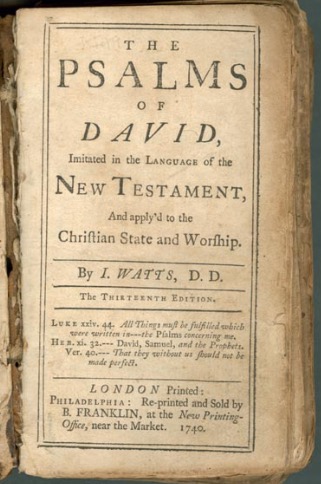
imageThat is the image it brings to mind when we sing Joy to the World. However, it is not the image Isaac Watts had in mind when he wrote that familiar song. It was originally published in his 1719 hymnbook titled The Palms of David: Imitated in the Language of the New Testament and Applied to the Christian State and Worship. How’s that for a catchy title?

Like many young people today, Watts found much of the congregational singing in the England of his day very uninspiring and lacking in passion. He once remarked “To see the dull indifference, the negligent and thoughtless air that sits upon the faces of a whole assembly, while the psalm is upon their lips, might even tempt a charitable observer to suspect the fervency of their inward religion.”

Seeking to energize congregational worship, Watts set out to write hymns based on the Psalms “in such a manner as we have reason to believe David would have composed them if he had lived in our day.” Some have called Isaac Watts the Chris Tomlin of his day.

Watts composed the words of Joy to the World based on Psalm 98, specifically the verses cited above. If you focus on those familiar lyrics, you can’t help but notice that there is no mention of those scenes and characters we all know so well from the Christmas story as told by Luke.

That is because Watts wrote the lyrics of Joy to the World with the Second Coming of Christ in mind, rather than his birth.

“Joy to the world, the Lord is come: Let earth receive her King!…. Joy to the earth, the Savior reigns: Let men their songs employ! … He rules the earth with truth and grace, and makes the nations prove the glories of his righteousness and wonders of his love.”

Several years ago, I began the practice of reading a different gospel account each month while continuing to read through the rest of the New Testament every six months. Following this schedule means that each December, I find myself both in John’s Gospel and in Revelation, John’s account of Christ’s return.

The combination of those two books of the Bible remind me that I live between two world-changing events – Christ’s incarnation, death, and resurrection and his promised return to gather those of us he died to save.

Just like a child on Christmas morning, as we celebrate his birth this year, may we equally anticipate and prepare our hearts for his promised return. Like Watts, may we long for that glorious day when the nations will indeed “prove the glories of his righteousness and wonders of his love.”

May each of you enjoy a Christ-filled and Christ-focused Christmas this year.

“The Spirit and the Bride say, ‘Come.’ And let the one who hears say, ‘Come.’ And let the one who is thirsty come; let the one who desires take the water of life without price. … He who testifies to these things says, ‘Surely I am coming soon.’ Amen. Come, Lord Jesus!” (Revelation 22: 17, 20 ESV)

The Durability of Scripture

“The grass withers and the flowers fall, but the word of our God endures forever.” (Isaiah 40:8 NIV)

One of the world’s leading sellers of fine jewelry is well known for their slogan, “A Diamond is Forever”. But long before De Beers coined that phrase, God assured us through the prophet Isaiah that the same is true for God’s Word.

This week I read an article in The Guardian online about the oldest surviving complete Latin Bible, the Codex Amiatinus, which was produced by monks in Northumbria in 716 A.D. and taken to Italy as a gift for Pope Gregory II. It is being returned on loan to the British Library in 2018 for an exhibition on the history, art, literature, and culture of Anglo-Saxon England.

This Bible is almost 18” thick and weighs more than 75 pounds. It is reported that over a thousand animal skins were needed to make its parchment. I can only imagine the number of hours those monks spent producing that single volume of the Holy Scriptures.

When Johannes Gutenberg produced the first book on a printing press around 1439 (a Latin Bible), there were only 30,000 books of any kind in all of Europe. This works out to about one book for every 2,500 people.

Nearly eighty years later, when Martin Luther launched the Reformation in 1517, twenty million books had been printed. More of those books were Bibles than anything else. Obviously, there was a great hunger for personal access to God’s written word.

We are blessed to live in a time when the Holy Scriptures are more widely accessible than ever before in the history of mankind. Here in my small office, there are seven Bibles, not counting four digital versions that are downloaded on my iPad.

Unfortunately, man’s hunger for God’s Word has not seemed to keep pace with increased access. I wonder sometimes if the Lord was speaking of the days in which we live when he moved the prophet Amos to write, “The days are coming, declares the Sovereign LORD, when I will send a famine through the land — not a famine of food or a thirst for water, but a famine of hearing the words of the LORD.” (Amos 8:11 NIV)

Never take for granted the privilege of owning your own personal copy of the Word of God, translated into language you can easily understand and apply in your life. Never read it nonchalantly – you are hearing the words of the Lord.

Take the advice of the psalmist and begin each day with it. “I rise before dawn and cry for help; I have put my hope in your word.” (Psalm 119:147 NIV) Reflect on its promises as you prepare for bed. “My eyes stay open through the watches of the night, that I may meditate on your promises.” (Psalm 119:148 NIV)

More than all the worldly distractions clamoring for your attention each day, it has the power to transform your life. And it will endure forever as a lamp to your feet and a light for your path. (Psalm 119:105)

“The soul can do without everything except the word of God, without which none at all of its wants are provided for.” – Martin Luther

The Centrality of Scripture

“All Scripture is inspired by God and is useful to teach us what is true and to make us realize what is wrong in our lives. It corrects us when we are wrong and teaches us to do what is right. God uses it to prepare and equip his people to do every good work. … Preach the word of God. Be prepared, whether the time is favorable or not. Patiently correct, rebuke, and encourage your people with good teaching.” (2 Timothy 3:16-17, 4:2 NLT)

The most disappointing words I’ve ever heard spoken from a pulpit still resound with me today. I was sitting with my mother listening to her pastor’s Mother’s Day message.

With my Bible open and ready to turn to the focal passage of the sermon, I listened as the pastor went on and on about the role and influence of a Godly mother.

I’m sure it all was very interesting and eloquent. But the only thing I remember from his message that day are the words he spoke at the end. Realizing that he had failed to cite any passages of Scripture, he declared, “Oh well. That message was good enough that it didn’t need any Scripture.” I almost fell out of my pew!

In contrast, sitting with my wife years later, the most memorable Mother’s Day message I’ve ever heard was delivered by our oldest son. It was titled “I Hate My Mother”. Now that will make a mother sit up and take notice when her son is preaching! While the title made it memorable, it was the multiple Scriptures he cited that made it effective.

It began with “If any man come to me, and hate not his father, and wife, and children, and brethren, and sisters, yea, and his own life, he cannot be my disciple.” (Luke 14:26 KJV) He then proceeded to lead us on a Scriptural journey to impress the point that, as much as we all might love our mothers, our devotion to Christ must be paramount.

Two very different messages. One tickled the ears of many who were listening that day but lacked Scriptural authority and was soon forgotten. The other might easily have offended some mothers in the congregation, but it was rooted in the truths of God’s Word and likely remembered still today by all who heard it.

This weekend, Protestant churches all across the world will be remembering the Reformation, commemorating the 500th anniversary of the publishing of Martin Luther’s Ninety-five Theses, which condemned the Catholic practices of indulgences. But the Reformation was about so much more than that.

The Reformation did not happen because of the passion of Martin Luther or his actions on October 31, 1517. It happened because of the power of God’s written Word. It became inevitable when people like John Wycliffe and William Tyndale devoted their lives to ensuring that each of us has access to a Bible we can read for ourselves, absorb into our minds, and apply in our lives.

Martin Luther said,

“From the beginning of my Reformation I have asked God to send me neither dreams, nor visions, nor angels, but to give me the right understanding of His Word, the Holy Scriptures; for as long as I have God’s Word, I know that I am walking in His way and that I shall not fall into any error or delusion.”

The Reformation did not begin or end with Luther. It continues today as Christian speakers, teachers, and writers build their messages around the Scriptures, rather than using the Scriptures to supplement human wisdom. As Luther himself said, “The authority of Scripture is greater than the comprehension of the whole of man’s reason.”

It continues as those of us who follow Christ recognize the blessing and privilege of unfettered access to God’s Word and make individual Bible study a daily priority. It advances as we live out Biblical principles in our lives and hold those tasked with the responsibility of preaching and teaching accountable for remaining true to the Scriptures.

We have no greater model for that than the Bereans Paul encountered in Acts 17:11. May we take their actions to heart and follow in their footsteps.

“Now the Berean Jews were of more noble character than those in Thessalonica, for they received the message with great eagerness and examined the Scriptures every day to see if what Paul said was true.” (Acts 17:11 NIV)