Timeless Truths

“The words of the wise are like goads, their collected sayings like firmly embedded nails – given by one shepherd. Be warned, my son, of anything in addition to them. Of making many books there is no end, and much study wearies the body. (Ecclesiastes 12:12 NIV)

Every new year brings with it the inevitable spike in gym memberships and sales of diet and exercise books. Many of us are looking for the latest exercise craze or fad diet that will help us achieve that fitness goal that eluded us last year. And yet, most of us know implicitly that maintaining good health and fitness comes down to a few simple rules: 

  • If we could give every individual the right amount of nourishment and exercise, not too little and not too much, we would have found the safest way to health.
  • Let food be thy medicine and medicine be thy food.
  • Walking is man’s best medicine.
  • That which is used – develops. That which is not used wastes away.
  • Everything in excess is opposed by nature. 

These “health rules” are simple, clear, straightforward, and unchanged for over 2,000 years. In fact, they were first articulated just as they are presented here by Hippocrates, a Greek physician who lived several hundred years before the birth of Christ. Rather than chase the latest fad, save yourself some money this year, ingrain these few timeless principles into your heart, and discipline yourself to follow them. 

The same applies to our approach to spiritual health. Walk in the door of any Christian bookstore and you will be immediately confronted with the latest bestseller by your favorite Christian author with his/her face prominently displayed on the cover promising “Your Best Life Now” or “30 Days to Spiritual Maturity”. You will likely encounter a wide assortment of devotionals offering nuggets of Biblical wisdom and spiritual insight for each day of 2017. 

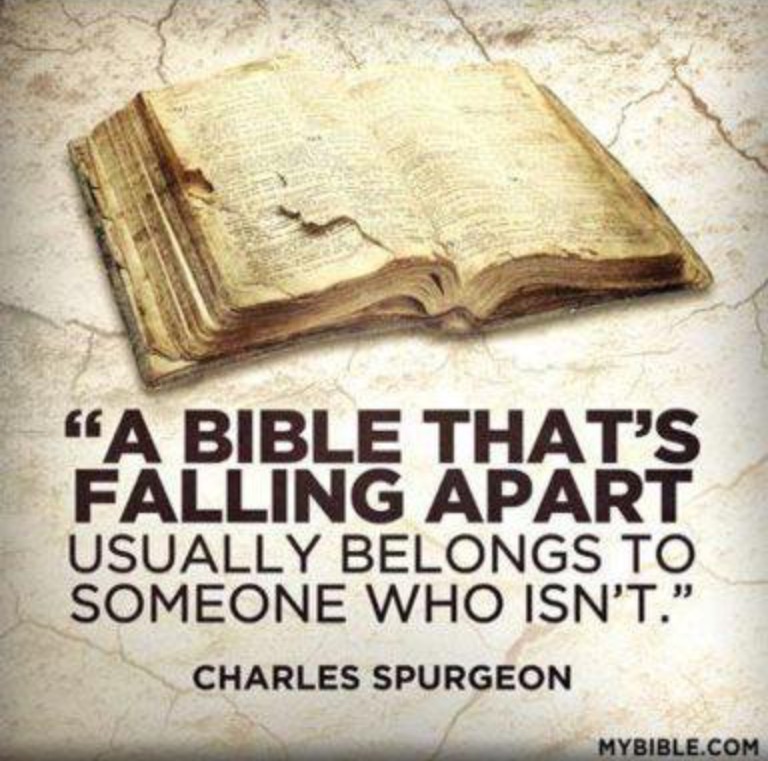
imageYou will have no difficulty finding these publications. They will be prominently displayed out front. But you may need a little assistance if you’re actually looking for a Bible. They will usually be tucked off to the side somewhere out of the way. Sadly, that is too often the case in our homes as well. 

Devotionals, Christian books, and religious blogs such as this one serve a useful purpose and my comments are not meant to denigrate them in any way or discourage you from reading them. (Certainly not mine!) But if they are your primary source of spiritual food, you will be woefully malnourished. If your goal is a stronger relationship with the Lord and improved spiritual fitness in 2017, there is simply no substitute for spending undistracted, quiet time in God’s Word. 

If it is not already your practice, I encourage you to resolve this year to begin each day reading and prayerfully digesting the clear, straightforward, and timeless truths found in the pages of your Bible. Ingrain its teachings into your heart and apply its principles in your life. There is simply no better source for spiritual nourishment and guidance than a clear word straight from the heart of the Creator and controller of the universe.

“What we need as Christians is to be able to feed ourselves. How many there are who sit helpless and listless, with open mouths, hungry for spiritual things, and the minister has to try to feed them, while the Bible is a feast prepared, into which they never venture.” – D.L. Moody


Reflections on 2016

“But one thing I do: Forgetting what is behind and straining toward what is ahead, I press on toward the goal to win the prize for which God has called me heavenward in Christ Jesus. (Philippians 3:13-14 NIV)

As 2016 has drawn to a close, there has been no shortage of articles in the media recounting the major news stories of this past year. Some are even portraying 2016 as the worst year ever. Personally, I think that reflects a short-sighted view of history and the tendency of the media to focus on the sensational, outrageous, and divisive rather than the uplifting and positive. And we certainly had plenty of the former this year. While many of you will stay up tonight to see 2017 come in, others may be more interested in seeing 2016 leave!

I am deeply grateful for each of you who found my posts worthy of your time this year. This is my 30th post of 2016, generating over 2500 views by more than 1600 visitors. I feel I have grown as a writer over the two years since starting Ridgetop Reflections, becoming more comfortable and proficient in that role. Much credit belongs to those of you who encourage me with your comments, shares, and likes.

imageBy far, my most popular post this year was Hope in the Face of Affliction, which was adapted from the eulogy I delivered at my brother’s funeral in 2015. Ronnie was dearly loved by many of you who follow this blog and that post was widely shared on social media. It received more than twice the number of views of any other post I have published to date. He would be pleased to know that the story of the spiritual growth he experienced in the face of years of physical suffering blessed many hearts. If you are new to Ridgetop Reflections and missed that post or if you would like to read it again, you may access it by <clicking here>.

Looking ahead to 2017, my goal is to post more often with shorter devotional-length articles. Several of you with more writing experience have been urging me in that direction. Given the amount of information that bombards us daily and the increasing impact of social media, I recognize the need to be more sensitive to the demands on everyone’s time these days.

imageAs the sun sets on another year, my prayer for you is the one offered by Paul in his letter to the Colossians. May God “fill you with the knowledge of his will through all spiritual wisdom and understanding.” May you “live a life worthy of the Lord” and may you “please him in every way: bearing fruit in every good work, growing in the knowledge of God, being strengthened with all power according to his glorious might so that you may have great endurance and patience, and joyfully giving thanks to the Father, who has qualified you to share in the inheritance of the saints in the kingdom of light.” (Col. 1:9-12 NIV)

If my posts in some small way assist you in that, may all glory be given to God, without whom I could write nothing of consequence. Thanks for honoring me with your time and especially for your encouraging feedback and contributions to the conversations.

Happy New Year to you all.

“The object of a New Year is not that we should have a new year. It is that we should have a new soul and a new nose; new feet, a new backbone, new ears, and new eyes. Unless a particular man made New Year resolutions, he would make no resolutions. Unless a man starts afresh about things, he will certainly do nothing effective.” – G.K. Chesterton

The Word Became Flesh

“And the Word became flesh and dwelt among us, and we have seen his glory, glory as of the only Son from the Father, full of grace and truth. … For from his fullness we have all received, grace upon grace. For the law was given through Moses; grace and truth came through Jesus Christ.” (John 1:14, 16-17 ESV)

While our most familiar Christmas accounts are found in the pages of Matthew and Luke, in recent years I have been drawn more to John’s account. As I mentioned in my last post, my annual Bible reading plan brings me to John’s Gospel each December. John’s presentation of the Christmas story is very unique from the other synoptic gospels because John’s purpose was uniquely different. Those other gospels focused heavily on presenting the detailed events of Jesus’ life. John’s purpose was to capture the person of Jesus Christ.

imageJohn’s account of Jesus’ birth was very plainly spoken. Only nine words in length, it can be easily memorized. But while short on words, it speaks volumes theologically. “And the Word became flesh and dwelt among us.” (John 1:14 ESV)  We sometimes miss the awesome impact of that simple truth in our own Christmas traditions. We are thrilled each year by the thought of the spectacle of that night. We imagine the majesty of the angel and the heavenly host that appeared to the shepherds; the simple, yet touching manger scene with the precious little baby wrapped in swaddling clothes.

I love what Luke says concerning Mary’s reaction to all the events of that night. While the shepherds gazed in awe and wonder at the spectacle and all who heard their story “were amazed at what the shepherds said to them”, Luke says Mary “treasured” them up and “pondered them in her heart.” (Luke 2:19 NIV) At Christmas, we could all use a little less hustling and bustling and a lot more treasuring and pondering … treasuring and pondering the person of Jesus Christ – who He is and why He came. And nobody answers those questions better than John in the pages of his gospel.

My wife and I have a grandson who has Asperger’s Syndrome. After his initial diagnosis, I sought to learn more about his particular form of autism spectrum disorder which, while often highly functioning, is still characterized by difficulties in social interaction and nonverbal communication. One of the more interesting books I read was The Journal Of Best Practices by David Finch. What made that book unique is that Finch actually has Asperger’s. He recorded this journal to help him remember basic rules for social interactions that most of us learned early in life through everyday experiences.

As I read his account, I was struck by how well the author describes his thought processes as he deals with situations most of us never even think about. Prior to being diagnosed, Finch and his wife suffered more than the usual marital conflicts. After his diagnosis, many of those conflicts began to resolve themselves as his wife learned more about Asperger’s. She began to understand why he responds differently to things than she does and he began to understand why the things that seemed perfectly normal to him were so upsetting to her. He started keeping the journal to train himself to act more in line with her expectations.

Finch was able to articulate his thought processes in a way my grandson cannot. When I read books about autism and Asperger’s, I know more about my grandson. But there’s a big difference between knowing about someone and truly knowing someone. After reading this very personal account from someone who actually has Asperger’s, I feel as though I truly know my grandson more intimately and personally.

From his unique perspective as the self-described “disciple whom Jesus loved“, (John 13:23) John offers us the most comprehensive and insightful look into the heart of God found in all of Scripture. He understood better than anyone that Jesus came to show us the Father; that he spoke to us the very words of God so that we can better know the Father more intimately and personally ourselves. 

Only through John do we hear Jesus tell Phillip, “Anyone who has seen me has seen the Father. … The words I say to you I do not speak on my own authority. Rather, it is the Father, living in me, who is doing his work. Believe me when I say that I am in the Father and the Father is in me.”  (John 14:10-11 NIV)

That is the unparalleled message of Christmas – that Jesus came to show us our Heavenly Father – a message so uniquely  and profoundly articulated by John with those memorable words, “And the Word became flesh and dwelt among us.” 

I pray that this Christmas you will ponder those words, treasure them in your heart, and reflect upon their implication for your life. El Shaddai, The Almighty God, is also Immanuel, God with us. May you experience the reality and the power of His presence this Christmas as never before. And the Gospel of John would be an excellent place to start!

“He is the radiance of the glory of God and the exact imprint of his nature, and he upholds the universe by the word of his power.” (Hebrews 1:3 ESV)

Joy To The World!

“Make a joyful noise to the Lord, all the earth; break forth into joyous song and sing praises! Sing praises to the Lord with the lyre, with the lyre and the sound of melody! With trumpets and the sound of the horn make a joyful noise before the King, the Lord! Let the sea roar, and all that fills it; the world and those who dwell in it! Let the rivers clap their hands; let the hills sing for joy together before the Lord, for he comes to judge the earth. He will judge the world with righteousness, and the peoples with equity.” (Psalm 98: 4-9 ESV)

It is certainly one of, if not the most, well-known Christmas carols. Most of us learned it at an early age and will sing it at least once during this Christmas season. As the Grinch would say, “It is both joyful and triumphant!” It captures so well the awe, wonder, and exuberance the shepherds must have felt that fateful night when an angel of the Lord appeared and announced “Today in the town of David a Savior has been born to you; he is Christ the Lord.” (Luke 2:11 NIV)

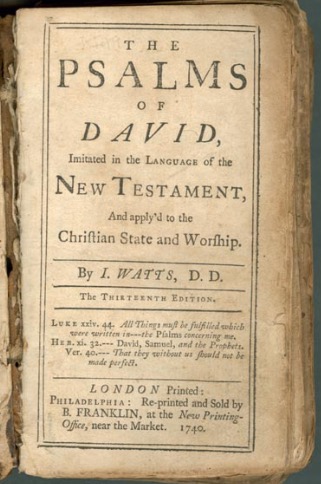
imageThat is the image it brings to mind when we sing Joy to the World. However, it is not the image Isaac Watts had in mind when he wrote that familiar song. It was originally published in his 1719 hymnbook titled The Palms of David: Imitated in the Language of the New Testament and Applied to the Christian State and Worship. How’s that for a catchy title?

Like many young people today, Watts found much of the congregational singing in the England of his day very uninspiring and lacking in passion. He once remarked “To see the dull indifference, the negligent and thoughtless air that sits upon the faces of a whole assembly, while the psalm is upon their lips, might even tempt a charitable observer to suspect the fervency of their inward religion.”

Seeking to energize congregational worship, Watts set out to write hymns based on the Psalms “in such a manner as we have reason to believe David would have composed them if he had lived in our day.” Some have called Isaac Watts the Chris Tomlin of his day.

Watts composed the words of Joy to the World based on Psalm 98, specifically the verses cited above. If you focus on those familiar lyrics, you can’t help but notice that there is no mention of those scenes and characters we all know so well from the Christmas story as told by Luke. That is because Watts wrote the lyrics of Joy to the World with the Second Coming of Christ in mind, rather than his birth.

As I have prepared my heart for Christmas this year, I have found myself focused on the return of Christ perhaps as much as his birth. Several years ago, I began the practice of reading a different gospel account each month while continuing to read through the rest of the New Testament every six months. Following this schedule means that each December, I find myself both in John’s Gospel and in Revelation, John’s account of Christ’s return.

The combination of those two books of the Bible remind me that I live between two world-changing events – that of Christ’s incarnation, death, and resurrection and of his promised return to gather those of us he died to save. As we celebrate his birth this year, may we be equally as anxious and prepared for his promised return, just like a child on Christmas morning. Like Watts, may we long for that glorious day when the nations will indeed “prove the glories of his righteousness and wonders of his love.”

May each of you enjoy a Christ-filled and Christ-focused Christmas this year, celebrating his birth while anticipating his glorious return.

“The Spirit and the Bride say, ‘Come.’ And let the one who hears say, ‘Come.’ And let the one who is thirsty come; let the one who desires take the water of life without price. … He who testifies to these things says, ‘Surely I am coming soon.’ Amen. Come, Lord Jesus!” (Revelation 22: 17, 20 ESV)

Can You Hear Me Now?

By: Julian Wells

“God again set a certain day, calling it ‘Today.’ This he did when a long time later he spoke through David, as in the passage already quoted: ‘Today, if you hear his voice, do not harden your hearts.’” (Hebrews 4:7)

Very few people are familiar with the name of Paul Marcarelli. But for years he was one of the most recognizable faces on television, appearing in countless Verizon commercials, cellphone to his ear, and repeating the phrase “Can you hear me now?” over and over, purportedly to demonstrate the far-reaching coverage of Verizon’s wireless network. Those words, “Can you hear me now?”, became an iconic catchphrase people often used when they suspected people were not paying attention to the words they were speaking.

imageI often think of those commercials when I read the Book of Hebrews. Three times in the span of two chapters, the author of Hebrews quotes from Psalm 95:7-8, “Today, if you hear his voice, do not harden your hearts.” (3:7,15, 4:7) Perhaps the most vital skill that a follower of Christ needs to develop and hone is learning to discern the voice of God from all the other voices that clamor for our attention.

Our lives today are packed with background noises that can easily distract us from vitally important things needing our focus. We pride ourselves on our ability to multitask. We eat while watching television; we listen to music while jogging; I watch Netflix while on the treadmill; my wife is even able to read a book and watch television at the same time.

However, studies have shown that when we multitask, we are never as efficient as we think we are at those activities. That is why automobile accidents have increased with the widespread use of cellphones. It is also why we should not multitask when it comes to reading God’s Word, which is the primary means through which we hear the voice of God.

I have made it a practice for many years to start the day by reading my Bible before anything else has a chance to distract my attention. But in order for it to impact our lives, we must do more than just read it – we must listen to God’s voice as he speaks to us through the Scriptures.

All too often, I have been guilty of reading just to maintain a Bible reading plan without truly digesting what God is saying to me, often prejudging the content to align with my own interpretations and inclinations, leaving little room for the Spirit to guide me in a different direction. We should never be so nonchalant about hearing the voice of God.

Years ago, after hearing a message by Dr. Charles Stanley on this topic, I recorded in the cover of my Bible these ten ways we should listen to God as we read his Word:

  • Eagerly
  • Attentively
  • Trustingly
  • Expectantly
  • Prayerfully
  • Patiently
  • Humbly
  • Purposefully
  • Joyfully
  • Repentantly

Remembering to adopt these postures as I read God’s Word has served me well through the years. When I do so, I rarely fail to hear God’s voice. He shows me things I’ve never noticed before. He feeds me, strengthens me, challenges me, humbles me, and gives me ideas for blog posts to share with you.

If your life is too busy to read the Bible this way, then your life is simply too busy and I strongly encourage you to evaluate your time and make adjustments. When Christ walked among us, it was clear to all who encountered him that his teaching was unlike any before him, and yet so many missed his glory and majesty. We must not make that same mistake by allowing trivial pursuits to keep us from the awesome privilege of hearing God’s voice through the pages of his Word.

“Christian believers make a great mistake when they refer only to the Bible as the Word of God. True, the inspired Bible is the Word of God speaking to our hearts and to our souls. But in referring to the Word of God, we do not mean just the book—printed pages sewed together with nylon thread. Rather, we mean the eternal expression of the mind of God. We mean the world-filling breath of God!” – A.W. Tozer

Note: All Scripture from the New International Version (NIV)